There are few kitchen disappointments more frustrating than slicing into an expensive steak and discovering a gray, dry interior instead of the rosy, juicy center you expected. I have watched home cooks blame the cut itself, the pan, the grill, or even the butcher, when the real issue was almost always a misunderstanding of temperature and protein behavior. Steak cookery is not guesswork, instinct, or luck. It is controlled heat management combined with an understanding of how muscle fibers, fat, water, and connective tissue react during cooking.
After more than 15 years of testing steaks in restaurant kitchens and home environments, I have found that most people overcook steak by relying on time instead of internal temperature. Two ribeyes cooked for the same number of minutes can finish completely differently depending on thickness, starting temperature, fat content, and cooking surface intensity. Once you understand what is physically happening inside the meat, achieving your preferred doneness becomes repeatable rather than stressful.
By the end of this guide, you will understand exactly why rare steak feels soft, why medium-well steak loses moisture rapidly, how carryover cooking changes the final result, and how to control heat precisely enough to produce consistently juicy steak regardless of the cooking method you use.
The Underlying Science of Steak Doneness
Steak is primarily composed of muscle fibers, water, fat, and connective tissue. The moment heat enters the meat, those components begin changing structure. The most important transformation involves proteins. Raw beef proteins are tightly folded molecules suspended in water. As temperature rises, those proteins denature, meaning they unravel and tighten. This tightening squeezes moisture outward from the muscle fibers.
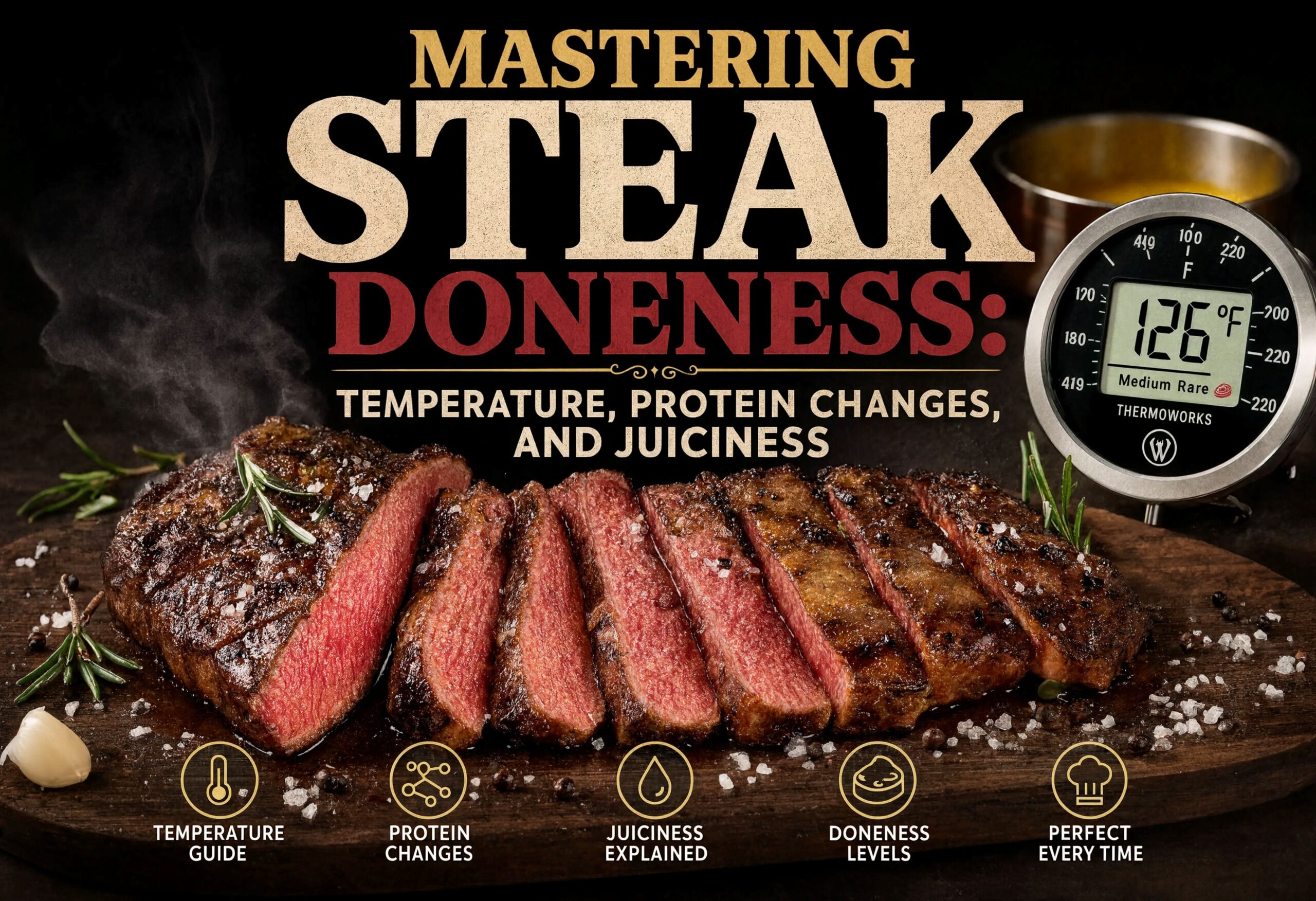
At around 120°F (49°C), the steak remains very soft because the proteins have only lightly coagulated. This is the rare stage, where the interior stays bright red and retains a high percentage of its moisture. Between 130°F and 140°F (54°C to 60°C), more proteins contract, but the meat still maintains enough water to feel juicy and tender. This is the temperature range where medium-rare and medium steaks develop their ideal balance between flavor concentration and moisture retention.
Once the internal temperature climbs beyond 150°F (66°C), muscle fibers tighten aggressively. Water loss accelerates, connective tissue begins firming instead of softening, and the steak becomes noticeably less juicy. This explains why well-done steak often feels chewy even when the cut itself is high quality. Moisture is physically expelled from the protein network.
Color changes are also driven by chemistry. Beef contains myoglobin, a protein responsible for oxygen storage in muscle tissue. Raw myoglobin appears purplish-red. As heat increases, the protein structure changes and the color transitions from red to pink to brownish-gray. Many cooks mistakenly believe juice color indicates doneness, but that liquid is mostly water mixed with dissolved proteins, not blood.
Fat behavior matters just as much. Intramuscular fat, often called marbling, begins rendering effectively between 130°F and 140°F. This rendered fat coats muscle fibers and creates the sensation of juiciness even as some water escapes. That is why highly marbled cuts like ribeye remain pleasurable at medium temperatures, while leaner cuts like filet mignon can dry out more quickly if overcooked.
Surface browning comes from the Maillard reaction, one of the most important flavor-building processes in cooking. When proteins and sugars are exposed to high dry heat, they form hundreds of aromatic compounds responsible for the deep crust and savory flavor associated with great steak. This reaction occurs most efficiently above roughly 300°F (149°C), which is why overcrowded pans and wet steak surfaces sabotage crust formation.
Step-by-Step Technique Guide
The single biggest improvement most home cooks can make is using a digital instant-read thermometer. In my kitchen, temperature measurement removed nearly all inconsistency from steak preparation. Touch tests and timing methods are unreliable because steak thickness varies too much.
Start by removing the steak from refrigeration about 30 to 45 minutes before cooking. This does not “bring it fully to room temperature,” despite popular claims, but it slightly reduces the temperature gradient between the center and exterior. A less extreme gradient promotes more even cooking.
Pat the steak aggressively dry with paper towels. Surface moisture converts into steam before browning can occur, and steam dramatically slows crust development. Season generously with salt shortly before cooking if you want a crisp exterior. Salting too early without sufficient resting time can initially pull moisture to the surface.
Choose a heavy cooking surface with strong heat retention. Cast iron remains one of the best options because it stores thermal energy efficiently and maintains stable surface temperatures when the steak makes contact. Thin pans cool too rapidly, leading to pale surfaces and uneven crust formation.
For most steaks between 1 and 1.5 inches thick, I prefer a two-stage cooking process. Begin with high heat to establish browning, then reduce heat slightly to finish the interior gently. Sear the first side until a dark crust develops naturally. If the steak sticks aggressively, it usually means the crust has not fully formed yet.
Flip more frequently than traditional cooking advice suggests. Repeated turning promotes more even internal heat distribution and reduces the gray overcooked band beneath the crust. During the final stages, add butter, garlic, and herbs if desired, spooning the foaming butter over the surface continuously.
Target pull temperatures rather than final temperatures. Steak continues cooking after removal because residual heat migrates inward. This carryover cooking usually raises internal temperature by 5°F to 10°F depending on thickness.
For reference:
- Rare: remove at 120°F to finish around 125°F
- Medium-rare: remove at 125°F to finish around 130°F to 135°F
- Medium: remove at 135°F to finish around 140°F to 145°F
- Medium-well: remove at 145°F to finish around 150°F
- Well-done: remove at 155°F to finish around 160°F
Resting the steak is essential. During cooking, moisture is driven toward the center by heat pressure. Resting allows pressure to redistribute more evenly throughout the meat. Slice immediately after cooking and those juices spill onto the cutting board instead of remaining inside the steak.
Comprehensive Troubleshooting Section
One of the most common failures is achieving a burned exterior with a raw center. This typically happens when the cooking surface is excessively hot relative to steak thickness. Thick steaks require either lower finishing heat or indirect cooking time after the initial sear. Reverse searing solves this particularly well by gently heating the interior first before applying intense surface heat.
Gray bands beneath the crust indicate prolonged exposure to aggressive heat. When steak sits untouched for too long, heat penetrates deeply from one direction, overcooking the outer layers before the center reaches target temperature. More frequent flipping helps reduce this issue substantially.
If the steak releases large amounts of liquid into the pan, surface moisture was likely too high or the pan temperature was insufficient. Excess liquid creates a steaming environment rather than browning conditions. The crust becomes pale, soft, and uneven instead of deeply caramelized.
Another common issue is dry steak despite “correct” final temperature. This often occurs because the steak was too lean or sliced incorrectly. Cutting against the grain shortens muscle fibers and creates a more tender bite perception. Grain direction matters more than many cooks realize, especially with cuts like flank steak or skirt steak.
Undercooked interiors can usually be rescued easily. Transfer the steak to a lower-temperature oven around 275°F (135°C) and continue monitoring with a thermometer until target temperature is reached. Overcooked steak is harder to fix because expelled moisture cannot truly be reabsorbed. In those situations, thin slicing combined with butter-based sauces can improve perceived juiciness.
Poor crust formation despite high heat often points to overcrowding. Multiple steaks in a small pan trap steam and reduce surface temperature dramatically. Airflow and evaporation are critical for efficient browning.
Frequently Asked Questions
Why does my steak continue cooking after I remove it from heat?
This is caused by carryover cooking. The outer layers of the steak become much hotter than the center during cooking. Once removed from the heat source, stored thermal energy continues moving inward. Thick steaks experience more carryover because they retain more internal heat mass.
Is medium-rare actually safer than rare?
Yes. Medium-rare steak reaches a higher internal temperature, which reduces bacterial survival on the surface. Whole-muscle steaks are generally safer than ground beef because bacteria primarily remain on the exterior, which is exposed to high searing temperatures during cooking.
Should I oil the steak or the pan?
I usually apply a thin layer of high-smoke-point oil directly to the steak surface. This promotes efficient heat transfer while reducing excess oil accumulation in the pan. Oils with low smoke points can produce bitter flavors during high-heat searing.
Why do restaurant steaks taste better than home-cooked steaks?
Restaurants often use higher-BTU cooking equipment capable of producing more aggressive Maillard browning. They also use generous seasoning, frequent basting, proper resting procedures, and high-quality beef with substantial marbling. The biggest difference, though, is temperature control. Professional kitchens monitor doneness constantly rather than relying on timing alone.
Does bone-in steak cook differently from boneless steak?
Yes. Bone acts as an insulating structure, slowing heat transfer slightly around adjacent meat. Bone-in steaks may cook less evenly but can retain moisture better near the bone. The difference is noticeable but not dramatic enough to completely change cooking strategy.
For authentic articles tastivohub.com